During my Ph.D. the main topic of my research was the seagrass Posidonia oceanica resilience in a climate change future scenario. I’ve always carried out experiments in the field, even though working in a real “natural laboratory” can be challenging sometimes.
The Mediterranean Sea is characterized by a wide range of temperature, changing through seasons but also from North to South and from East to West, and many species living here just adapted themselves to different temperature variations. Cyprus was a good place for me to test P. oceanica at different temperature from where my base was (Sardinia). In fact, this big island is far from the Gibraltar strait, where the cold water of the ocean enters the basin, but also close to the Suez channel where the warmer water of the Red Sea can enter the basin.

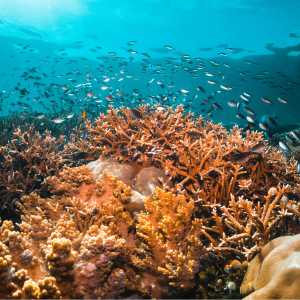
In summer 2022, the period of my experiment, the temperature of the water in the South-East of Cyprus reached 30°C on the surface but also 29°C down to 28m! I was shocked! The first thought is “niiiice, I can easily dive in my bikini!”, but immediately after I realized that it’s not normal, and the reason why we have such warm temperatures, is because of climate change. Apart from the high temperature, once I had jumped in the water, I realized that the fauna around was weird! P. oceanica is endemic to the Mediterranean Sea, but the temperature and the surroundings in that area made me feel I was diving in a tropical place! Trumpetfish, parrotfish, lionfish were swimming around me even though they are not species that normally live in the Mediterranean Sea. What’s happening? The Mediterranean Sea is going through a tropicalization, the increased occurrence of the warm-water biota (Bianchi and Morri, 2003). This phenomenon is the result of four different actions: Atlantic influence, lessepsian migration (species from the Red Sea), species introduction by humans, and seawater warming.

Species from the Red Sea are moving through the Suez channel to the Mediterranean Sea following the warm water flux, and almost 1000 alien species have already moved to warming waters and replaced endemic species to the Mediterranean Sea. These species will find good conditions to live and reproduce apart from the temperature range they used to live in, they will find a good place for shelter, prey to eat and no predators to run away from.

The goals of the projects are the following:
- Develop the necessary capacity and mechanisms in Cyprus, so the country can act promptly and effectively against the lionfish invasion, and other invasive species from the Red Sea
- Demonstrate the effectiveness of a range of lionfish invasion prevention measures, such as the development and implementation of an early surveillance and detection system and a removal response system
- Build capacity and knowledge which can be transferred and replicated by other countries of the Mediterranean, so they can control lionfish expansion in their waters.
(For more info please visit https://relionmed.eu).

In conclusion…
To make a long story short, surely it was nice to see tropical species in the Mediterranean Sea, but it is much better (and healthier) seeing them in their real habitat!
Bianchi, C. N., & Morri, C. (2003). Global sea warming and “tropicalization” of the Mediterranean Sea: biogeographic and ecological aspects. Biogeographia–The Journal of Integrative Biogeography, 24(1).
Jimenez, C., Andreou, V., Hadjioannou, L., Petrou, A., Alhaija, R. A., & Patsalou, P. (2017). Not everyone’s cup of tea: Public perception of culling invasive lionfish in Cyprus. Journal of the Black Sea/Mediterranean Environment, 23(1), 38-47.